Panels & Service Upgrades
Electrical Panels & Service Upgrades
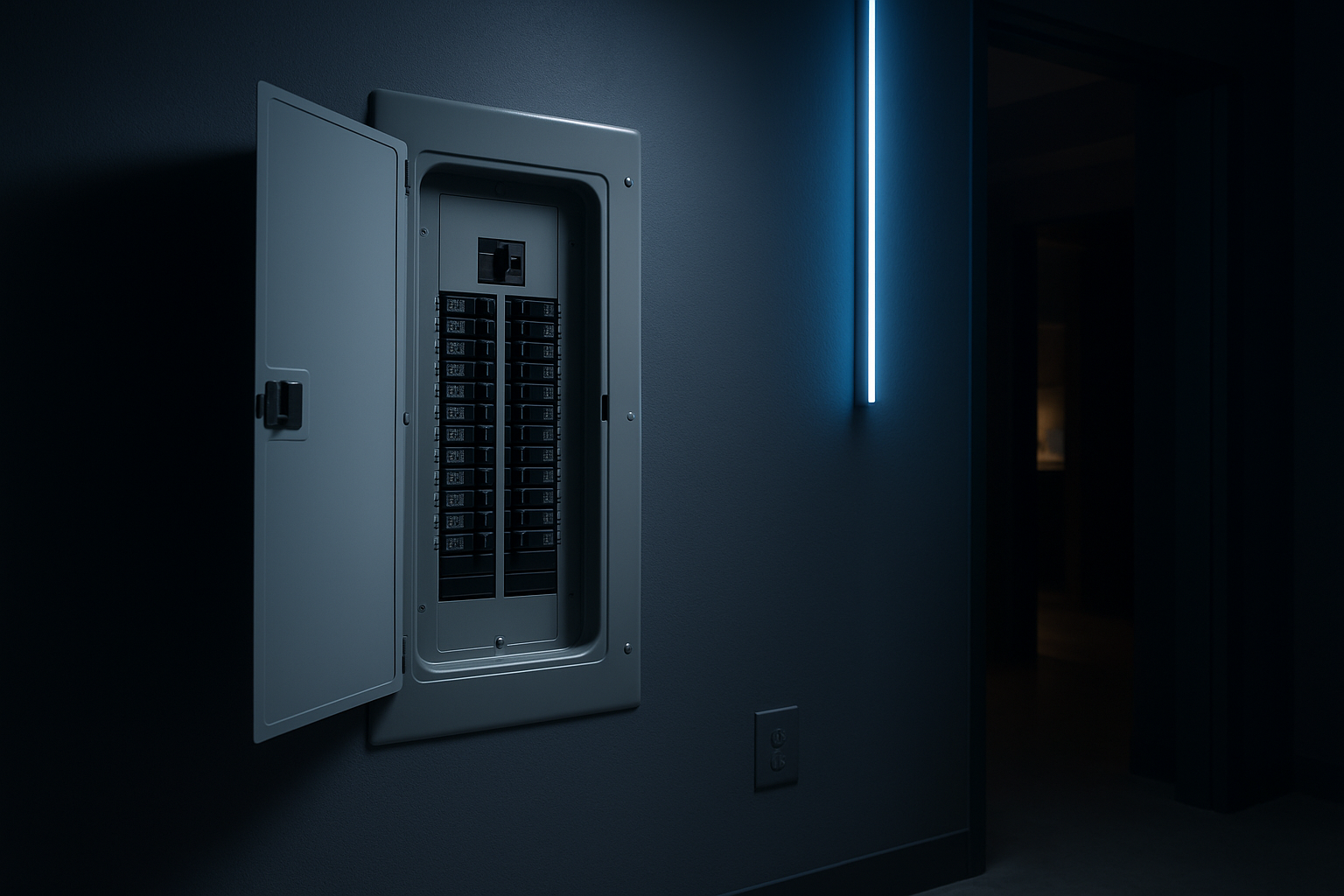
Your electrical panel is the heart of your home's electrical system. Panel replacement, service upgrades, load evaluation, breaker work and surge protection — the category that quietly enables everything else in the house.
What we do at the panel
Seven jobs that live inside — or right next to — the service panel.
Not every homeowner needs every one of these. The point is that if a panel needs work, we do the full range — you do not need a second contractor for the piece we do not do.
-
Panel installation and replacement.
A full swap when the existing panel is at the end of its service life, is a known-recalled brand, or was undersized for the way the house is now used. We coordinate the utility, pull the permit, and land the new panel bonded and grounded to standard.
-
Panel and service upgrades.
Raising the service size — 60A to 100A, 100A to 200A, 200A to 400A — to accommodate an EV, a heat pump, an induction range, or simply the way modern homes now draw power. The meter, the mast, the main and the panel all move together in the same job.
-
Circuit-breaker replacement.
Failed breakers, mismatched breakers, and — where the panel is otherwise sound — a legitimate one-for-one swap. Not every breaker problem is a panel-replacement problem; we say so plainly when it is not.
-
New circuit installation.
A dedicated 20A run for a home office, a 30A dryer, a 40A range, a 50A EV charger, a subpanel for a garage or workshop. New circuits pull off the existing panel where there is capacity, or a subpanel when there is not.
-
Load evaluation.
A calculated look at what the panel is actually being asked to deliver, using the current NEC method. The number on the label is the maximum; the load calc tells you the room you have.
-
Panel troubleshooting.
Warm breakers, tripping under specific loads, a burning smell that only shows up in one room. We diagnose at the panel first — most branch-circuit mysteries have a panel-side story to them.
-
Surge-protection solutions.
Whole-home surge protective devices installed at the panel, plus point-of-use suppression at anywhere sensitive electronics live. See the surge section below for the honest story on what it does and does not do.
When homeowners typically look at a panel upgrade
Six honest scenarios.
Every scenario below is worth a professional evaluation. None of them is "you need an upgrade" from a web page — that decision only happens after we open the panel and run the numbers.
-
Older home with 60A or 100A service and modern loads.
Pre-1970s homes often shipped with 60A or 100A service that is now being asked to carry a dishwasher, dryer, microwave, HVAC, and a laptop farm the original panel was never sized for.
-
Adding an EV charger.
A Level-2 EV charger typically wants a 40–50A dedicated circuit. On a 100A service that is close to full already, a load management device or a service upgrade is usually part of the conversation.
-
Planning a heat pump conversion.
Air-source heat pumps, heat-pump water heaters, and induction ranges all move load from gas to electricity. Doing that in the right order — panel headroom first — saves the homeowner from paying to open the same wall twice.
-
Frequent breaker trips.
Trips that happen every time the microwave runs while the toaster is on. Trips that happen when the vacuum is plugged in on the same circuit as the AV rack. Sometimes it is the breaker; often it is the branch circuit; occasionally it is the panel.
-
Fuse boxes or known-recalled panel brands.
Federal Pacific Stab-Lok, Zinsco, Pushmatic, and some early Challenger series panels have documented safety concerns. Fuse boxes still work — the issue is capacity and the compatibility problems that come from swapping in modern loads.
-
Visible corrosion, scorch marks, or warm breakers.
If a panel shows signs of heat where there should not be any — melted casings, discolouration, an odd smell in the utility room — do not wait for the qualification form. Call.
Load evaluation
The panel says 200A. The load calc says what you can actually add.
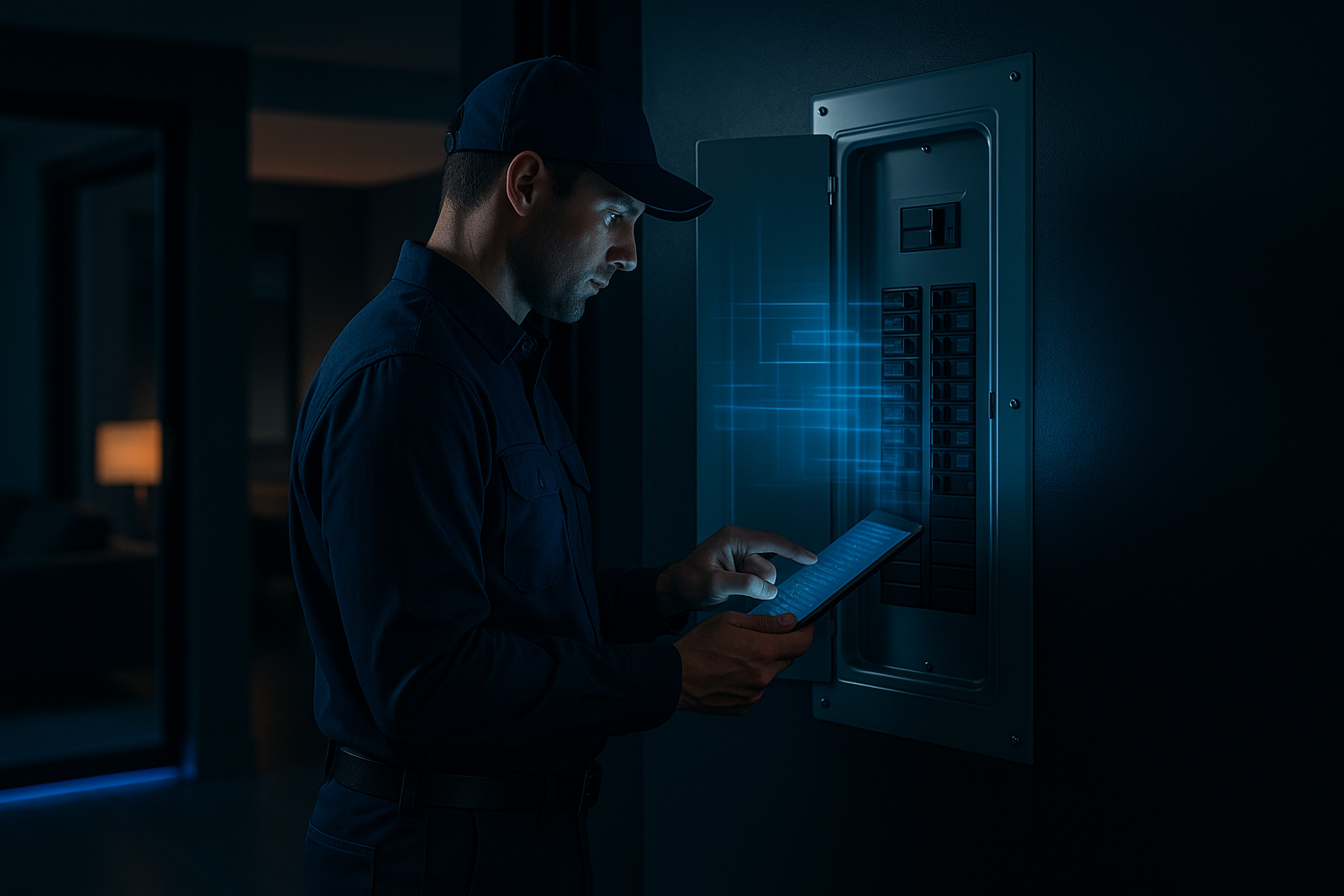
A load calculation is a structured look at every fixed and variable load on the service — heating, cooling, cooking, laundry, water heating, general lighting and receptacles, and any special-purpose circuits like an EV charger or heat pump. The method is defined in the current NEC and produces a real, defensible number for the electrical demand the service is being asked to carry.
The reason it matters: two identical 200A panels in two identical houses can have wildly different real capacity depending on what is already connected to them. The label is the maximum the service is rated for; the load calc tells you the headroom.
Whole-home surge protection
A small, high-value add during any panel work.
A whole-home Surge Protective Device (SPD) mounts at or in the service panel and clamps transient overvoltages before they reach branch circuits. It protects everything downstream of the panel — the HVAC control board, the refrigerator's inverter, every wall wart plugged into a receptacle in the house.
Honest scope: an SPD reduces the risk from transient overvoltage — a nearby lightning event, a utility-side switching transient, a large inductive load on the same feeder. It is not a magic shield. A direct lightning strike on the service mast is a different conversation, and no residential-scale SPD is going to save equipment from a service-entrance-level surge event of that magnitude. What an SPD reliably does is take out the everyday transients that quietly shorten the life of expensive electronics.
The current NEC treats whole-home surge protection as a standard component of a service panel replacement. When we replace or upgrade a panel, we install an SPD as part of the standard scope unless a homeowner declines it.
Permits and inspections
This work is permitted work. We handle it.
Panel and service work is a permitted electrical operation in essentially every jurisdiction. KC Smart Services pulls the permit, coordinates the inspection, and when the service upgrade involves the meter, we coordinate the utility disconnect and reconnect. A homeowner should never be handed a permit application to fill out themselves — that is the contractor's job, and it is included in our scope.
Answer 12 questions — we'll give you a plain-English read on whether a panel evaluation is worth booking.
Two minutes. No obligation. No dollar promises. You walk away with a printable summary.